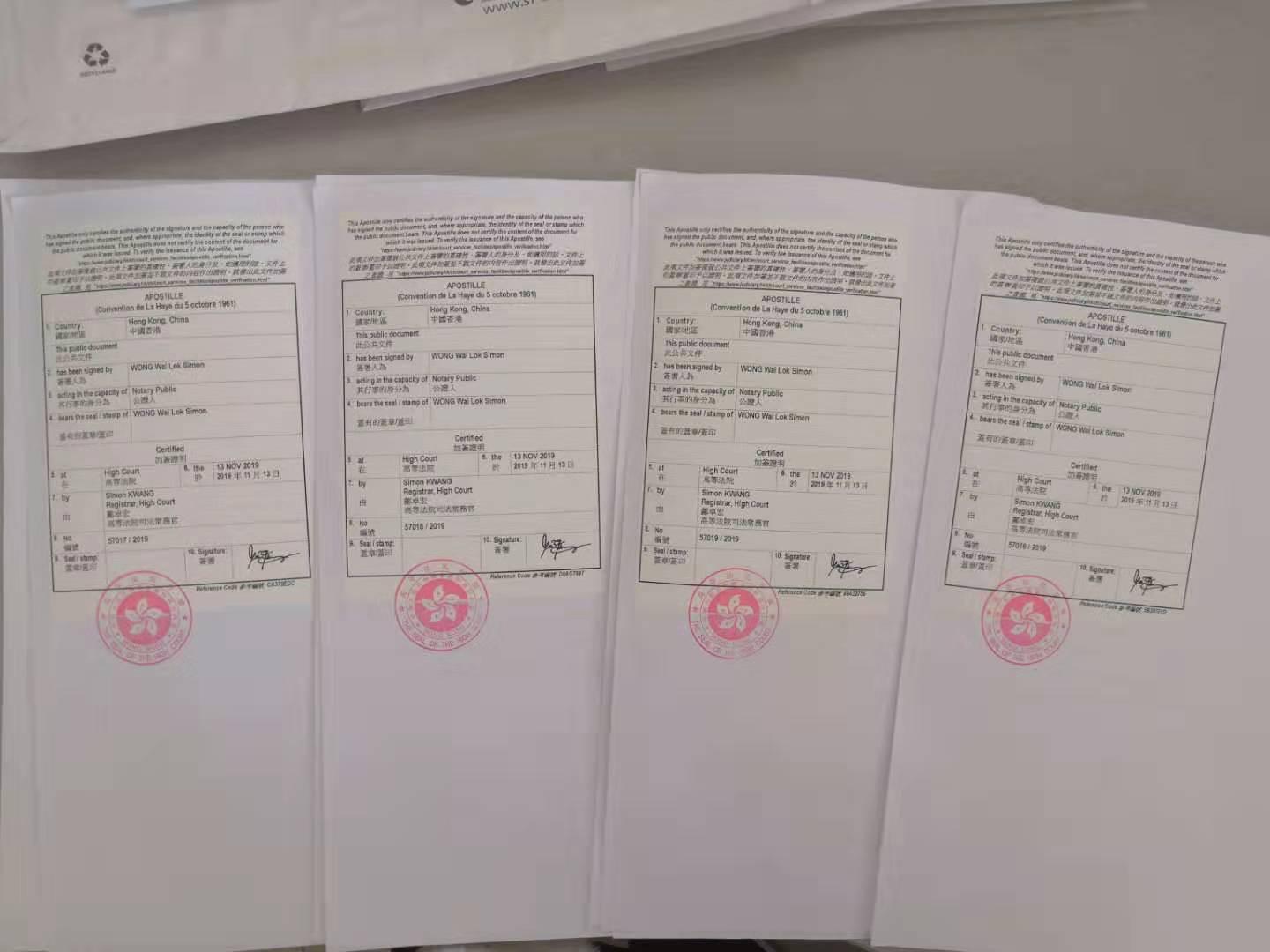
Apostille of Documents in Hong Kong

An apostille is a specialized certificate that authenticates the origin of a public document (like birth certificates, court orders, or notarized documents) for use in another country. It is issued under the terms of the 1961 Hague Convention Abolishing the Requirement of Legalisation for Foreign Public Documents. Hong Kong, as a Special Administrative Region of China, continues to apply the Hague Apostille Convention separately.

Why is an Apostille Needed in Hong Kong?
If you have a Hong Kong public document that must be presented in another country that is also a member of the Hague Apostille Convention (e.g., the USA, Japan, Germany, Australia), you will likely need an apostille. It simplifies the legalization process, replacing the more cumbersome chain of authentications.

Procedure in Hong Kong:
The High Court of Hong Kong is the designated Competent Authority for issuing apostilles.

1. Document Type: Ensure your document is a “public document.” This includes:
  · Original documents issued by Hong Kong government departments (birth/death/marriage certificates, company registry extracts).
  · Documents notarized by a Hong Kong notary public (affidavits, powers of attorney, copies of passports).
  · Official documents signed by certain other officials (e.g., court documents).
2. Submission: You or your legal representative must submit the original document (or a notarized copy) to the Apostille Section of the High Court Registry.
3. Processing: The Court verifies the signature/seal on the document. Once confirmed, they attach or stamp the apostille certificate onto the document.
4. Time & Cost: Processing is typically fast, often within one working day. Fees apply and should be confirmed on the Hong Kong Judiciary website.

Important Notes:

· For use in Mainland China: Since Mainland China is a member of the Hague Convention but applies it differently to Hong Kong, documents destined for the Mainland usually require a different process called “Legalisation” through the China Legalisation Office in Hong Kong, not a simple apostille.
· For use in non-Hague Convention countries: Full legalization through consulates or embassies is required.

Always check the specific requirements of the receiving country before proceeding.

Share Capital in Hong Kong: Requirements, Structure, and Key Considerations

When incorporating a private limited company in Hong Kong, one of the fundamental decisions founders must make concerns the company’s share capital. Hong Kong’s corporate regime, governed by the Companies Ordinance (Cap. 622), is known for its flexibility and business-friendly approach. This is particularly evident in its rules regarding share capital, which offer significant freedom to entrepreneurs.

1. No Mandatory Minimum Paid-Up Capital

A key advantage of incorporating in Hong Kong is that there is no statutory minimum amount of paid-up share capital. A company can be formed with a share capital as low as HK$1.00. This low barrier to entry facilitates easy startup formation and is a major reason for Hong Kong’s vibrant entrepreneurial ecosystem.

· Important Note: While there is no minimum for general companies, specific regulated industries (e.g., licensed financial institutions, insurance companies, securities firms) have their own capital requirements imposed by regulatory bodies like the Securities and Futures Commission (SFC) or the Hong Kong Monetary Authority (HKMA).

2. Understanding Key Terminology: Authorized vs. Issued Share Capital

Under the current Companies Ordinance, the concept of “authorized share capital” has been abolished for companies incorporated after its enactment. The focus is now on:

· Authorized Share Capital (for older companies): Pre-2014 companies may still have a clause in their Articles of Association limiting the maximum number of shares they can issue. This can be removed by a special resolution.
· Issued Share Capital: This refers to the total value of shares that have actually been allotted (issued) to shareholders. This is the figure that represents the capital held by the company.

3. Currency Flexibility

A company’s share capital can be denominated in any currency (or multiple currencies), providing great flexibility for international businesses. The most common choices are Hong Kong Dollars (HKD), US Dollars (USD), or Chinese Renminbi (RMB). The chosen currency must be clearly stated in the company’s incorporation documents (Form NNC1) and its Articles of Association.

4. Types of Shares and Share Rights

Hong Kong law allows for different classes of shares, each with distinct rights attached. The most common is the ordinary share, which typically carries one vote per share and equal rights to dividends and capital. However, companies can create:

· Preference Shares: Offering a fixed dividend priority but usually no voting rights.
· Redeemable Shares: Shares that the company can buy back under agreed terms.
· Shares with Different Voting Rights (e.g., Weighted Voting Rights): Permitted under specific rules, often used by listed companies.

The rights, privileges, and restrictions of each share class must be explicitly defined in the company’s Articles of Association.

5. Payment for Shares

Shares can be paid for in several ways:

· Cash: The most straightforward method.
· Non-Cash Consideration (Assets or Services): Shares can be issued in exchange for the transfer of assets (e.g., intellectual property) or past services. It is crucial to have a proper valuation and record this in board minutes.

Paid-up vs. Unpaid Capital: While capital can be issued, it does not necessarily have to be fully paid up immediately. For example, a company with HK$10,000 in issued capital may have only HK$2,000 paid up by shareholders, leaving HK$8,000 as unpaid capital (a debt owed by shareholders to the company). However, for most small private companies, it is standard and recommended to have the issued capital fully paid up upon incorporation to simplify matters.

6. Increasing or Reducing Share Capital

· Increasing Capital: A common procedure. The company, by an ordinary resolution, can create new shares and issue them to existing or new shareholders.
· Reducing Capital: More complex and requires a special resolution (75% shareholder approval) and court confirmation unless it falls under a specific solvency-based procedure outlined in the Companies Ordinance. This process ensures creditor protection.

7. Practical Considerations and Common Pitfalls

· Not Just a Formality: While the amount can be small, the structure of share capital is a critical legal foundation. It affects control (voting), profit distribution (dividends), and liability.
· Adequacy for Operations: While the legal minimum is HK$1, the issued capital should be reasonable and adequate for the company’s intended business operations and initial expenses.
· Public Record: The details of a company’s issued share capital are part of its public file at the Companies Registry, accessible by anyone.
· Stamp Duty: A fixed duty of HK$5 is payable on the return of allotment (Form NSC1) for issued shares, regardless of the capital amount or currency.


Hong Kong’s approach to share capital is characterized by maximum flexibility and minimal red tape, aligning with its status as a premier global business hub. The absence of a mandatory minimum paid-up capital removes a significant financial barrier for startups. However, this flexibility demands careful planning. Founders should thoughtfully determine the amount, currency, and class structure of shares, ensuring it is documented correctly in the Articles of Association. For any non-standard capital structure or questions regarding adequacy, seeking advice from a corporate service provider or legal professional is highly recommended to lay a solid foundation for future growth and investment.

Choosing the Right Company Address in Guangzhou

Establishing a company in Guangzhou, the commercial heart of Southern China, is a strategic move. Your business address is more than just a location; it’s a statement about your company’s profile, credibility, and ambitions. Selecting the right district can significantly impact your operations, client perception, and access to talent.

Key Business Districts in Guangzhou:

1. Tianhe District (天河区) – The Modern CBD
  · Profile: The undisputed financial and commercial core of Guangzhou. It’s home to skyscrapers, multinational corporations, and high-end shopping malls.
  · Ideal For: Finance, IT, consulting, legal firms, multinational corporations, and any business that requires a prestigious image.
  · Landmarks: Guangzhou Twin Towers (CTF Finance Centre & Guangzhou International Finance Place), Tianhe Sports Center, Zhujiang New Town.
  · Advantages: Top-tier infrastructure, excellent transportation (multiple metro lines), high concentration of talent and clients.
  · Considerations: The highest office rental costs in the city.      

  2. Yuexiu District (越秀区) – The Traditional & Political Center
  · Profile: The historical heart of Guangzhou, hosting the provincial and municipal government offices. It blends traditional commerce with political significance.
  · Ideal For: Government relations (lobbying), traditional trading companies, legal firms, NGOs, and cultural enterprises.
  · Landmarks: Beijing Road Pedestrian Street, Yuexiu Park, Provincial Government Headquarters.
  · Advantages: Established business environment, strong government resources, rich cultural history.
  · Considerations: Older infrastructure, traffic congestion can be an issue.            

   3. Haizhu District (海珠区) – The Emerging & Creative Hub
  · Profile: Known for its innovation and creativity, anchored by the massive Guangzhou International Convention and Exhibition Center (Pazhou Complex).
  · Ideal For: E-commerce, tech startups, advertising, media, and all companies involved in import/export trade and exhibitions.
  · Landmarks: Canton Fair Complex, Guangzhou Tower (across the river), Pazhou Internet Innovation Cluster.
  · Advantages: Modern exhibition facilities, growing tech scene, relatively more affordable than Tianhe.
  · Considerations: Still developing in some areas, traffic can be heavy during major events like the Canton Fair.

4. Nansha District (南沙区) – The Free Trade Zone & Future Gateway
  · Profile: A national-level New Area and Free Trade Zone located by the Pearl River Estuary. It focuses on advanced manufacturing, shipping, and international trade.
  · Ideal For: Manufacturing, logistics, international trade, shipping companies, and businesses looking for significant tax incentives and policy support.
  · Landmarks: Nansha Port, Nansha Free Trade Zone.
  · Advantages: Attractive tax benefits, streamlined customs procedures, ample space for development.
  · Considerations: Far from the city center (about 1-hour drive), still under large-scale development.

Important Considerations When Choosing an Address:

· Virtual Offices & Serviced Offices: For startups and small businesses, serviced offices (e.g., Regus, Sparkeagle) or virtual office services provide a prestigious address and secretarial services without the cost of a full lease. This is a highly popular and cost-effective way to start.
· Legal Registration: The address must be suitable for commercial use and able to be registered with the local Administration for Market Regulation (市场监督管理局). Not all residential or mixed-use properties can be registered.
· Accessibility: Proximity to metro stations (e.g., Lines 3, 5, and the APM in Tianhe) is a major advantage for both employees and clients.

Final Steps:
Once you select a district, work with a local real estate agent who specializes in commercial property. They can help you navigate the leasing process, ensure the property can be legally registered, and negotiate favorable terms. Your address in Guangzhou will be the foundation of your brand’s story in one of the world’s most dynamic economies.

How Successfully Open a Branch of Your Company in China

branch

Expanding your business into China is a significant step towards tapping into one of the world’s most dynamic consumer markets. However, the process involves navigating a unique legal, regulatory, and cultural landscape. A common and strategic entry model for foreign companies is establishing a Branch Office (分公司, Fēn Gōngsī).

This guide will walk you through the key steps, requirements, and considerations for opening a branch in China.

What is a Branch Office in China?

A Branch Office is an extension of its foreign parent company. It is not a separate legal entity. This means the parent company bears full liability for the branch’s debts and obligations. A branch is suitable for non-profit generating activities such as:

· Market liaison and research
· Product promotion and marketing
· Coordination with suppliers and partners
· After-sales services and support

Crucial Note: A Branch Office is generally not allowed to engage in direct profit-making activities like signing sales contracts or issuing invoices. For that, you would need to establish a Wholly Foreign-Owned Enterprise (WFOE).

Key Steps to Establish a Branch Office in China

1. Pre-Establishment Assessment & Planning

· Define Your Scope: Clearly outline the representative activities your branch will perform.
· Choose a Location: Select a city that aligns with your industry, such as Shanghai, Beijing, Shenzhen, or Guangzhou. Consider factors like target market, logistics, and local government incentives.
· Secure a Registered Address: You must have a physical office address to complete registration. Virtual offices are generally not acceptable.

2. Obtain Necessary Approvals

· Company Documents: Prepare notarized and legalized copies of your parent company’s Certificate of Incorporation, Articles of Association, and Board Resolution approving the branch’s establishment.
· Appoint Chief Representative: Designate a Chief Representative who will act as the legal head of the branch in China.

3. Registration with Chinese Authorities
The process typically involves multiple government bodies:

· State Administration for Market Regulation (SAMR): Submit all documents for official registration and obtain a Business License.
· Customs: If you plan to import samples or exhibits, you must register.
· Statistics Bureau: Register for statistical reporting.
· Foreign Exchange Bureau: Register to facilitate foreign currency transactions.

4. Post-Registration Formalities

· Corporate Bank Account: Open a RMB and foreign currency bank account with a local Chinese bank.
· Tax Registration: Register with the State Taxation Bureau and Local Taxation Bureau. Understand your tax obligations, including Corporate Income Tax and Value-Added Tax (VAT).
· Social Security Registration: Register your employees with the local social security bureau to make mandatory contributions.

Key Considerations and Challenges

· Liability: Remember, the parent company has unlimited liability.
· Funding: The operational costs of the branch must be funded by the parent company. The branch cannot generate its own revenue.
· Compliance: Strict adherence to Chinese accounting, tax, and reporting standards is mandatory. Hiring a local accounting firm is highly recommended.
· Cultural and Language Barrier: Navigating bureaucracy requires local expertise. Partnering with a professional services firm specializing in China market entry is invaluable.

Opening a branch office in China is a viable strategy for market testing, building brand presence, and facilitating non-sales operations. While the process is complex, thorough preparation and understanding of the regulations can lead to a successful establishment. For most profit-oriented activities, however, setting up a WFOE remains the preferred and more flexible option.

A Comprehensive Guide to Company Verification in Hong Kong

In the dynamic and internationally-oriented business environment of Hong Kong, conducting due diligence on a potential partner, supplier, or client is not just prudent—it’s essential. Company verification, often the first step in this process, provides critical insights into a company’s legitimacy, financial health, and corporate standing. Fortunately, Hong Kong’s transparent regulatory framework makes this process systematic and accessible.

Why Verify a Hong Kong Company?

· Risk Mitigation: To avoid fraud, scams, and partnerships with shell companies.
· Investment Decisions: To assess the credibility and financial stability of a target company.
· Regulatory Compliance: To meet “Know Your Customer” (KYC) and anti-money laundering (AML) obligations.
· Partnership Assurance: To confirm the legal status and good standing of a potential partner before signing contracts.

Key Steps and Sources for Company Verification

1. Search the Official Companies Registry (ICRIS)

The Integrated Companies Registry Information System (ICRIS) is the primary and most authoritative source for company data in Hong Kong. Managed by the Companies Registry, this online portal provides access to fundamental information about any registered Hong Kong company.

· What you can find:
 · Company Name and Registration Number
 · Company Status (e.g., “Live”, “Dissolved”, “Deregistered”) – This is crucial.
 · Date of Incorporation
 · Registered Office Address
 · Information on Directors and Company Secretary
 · Certificate of Incorporation and Business Registration Certificate (for a fee)
· How to access: You need to register for an ICRIS online account. Basic information is available for free, while more detailed documents require payment of a small fee.

2. Verify the Business Registration Certificate (BRC)

Every company operating in Hong Kong must have a valid Business Registration Certificate issued by the Inland Revenue Department (IRD). The BRC displays the company’s name, registration number, and the validity period of the certificate. Ensuring it is current is a basic check.

3. Analyze Financial Statements (for Limited Companies)

While private companies’ detailed financial statements are not always public, Hong Kong law requires companies to file an Annual Return (Form NAR1) each year. For smaller private companies, this may include simplified reporting. However, for a deeper financial health check, you can:

· Request financial statements directly from the company.
· Check if the company has filed any charges (e.g., mortgages) against its assets, which is public record in ICRIS.

4. Check for Litigation and Legal Proceedings

While not consolidated in a single database, you can check:

· The Hong Kong Judiciary website for court case searches.
· The Official Receiver’s Office for winding-up and bankruptcy records.

5. Conduct On-the-Ground Due Diligence

For high-stakes engagements, consider:

· Visiting the company’s registered office.
· Checking industry-specific licenses and memberships.
· Using the services of professional investigative firms or law firms in Hong Kong for a comprehensive background check.

Red Flags to Watch Out For

· Mismatched Information: The company’s website, business card, or invoice address does not match its registered office address.
· Suspended or Dissolved Status: The company is not in “Live” status in ICRIS.
· Expired Business Registration Certificate.
· Nominee Directors with No Track Record: A company where all directors appear to be nominal, with no other business history.
· Unverifiable Physical Presence: No verifiable office, landline phone number, or staff.

Company verification in Hong Kong is a straightforward yet powerful process, largely thanks to the transparency of the ICRIS system. By systematically checking the official records, businesses and investors can significantly reduce their risks, build trust with legitimate partners, and make informed decisions in one of the world’s most competitive markets. A small investment of time and resources in due diligence can prevent substantial financial and reputational losses down the line.

Company Registration Authorities in China: A Guide to SAMR and Beyond

branch

Navigating the business landscape in China requires a clear understanding of its administrative framework. Contrary to systems in many Western countries, company registration in China is a centralized and hierarchical process, with the State Administration for Market Regulation (SAMR) at its apex. This guide explains the key authorities responsible for company registration in the People’s Republic of China.

The Primary Authority: State Administration for Market Regulation (SAMR)

The State Administration for Market Regulation (SAMR, 国家市场监督管理总局) is the supreme body overseeing market regulation, enterprise registration, and intellectual property rights in China. Established in 2018, it consolidated several previous agencies to create a more streamlined regulatory environment.

SAMR’s key responsibilities include:

· Company and business registration.
· Market supervision and regulation.
· Anti-monopoly enforcement.
· Product quality and food safety supervision.
· Management of intellectual property (patents, trademarks).
· Standardization and certification.

The Local Implementation: Administration for Market Regulation (AMR)

While SAMR sets national policy, the actual registration process is handled by its local branches. These are known as Administrations for Market Regulation (AMRs) at the provincial, municipal, and district/county levels.

· For a foreign company registering in Shanghai: You would submit your application to the Shanghai Municipal Administration for Market Regulation.
· For a small domestic company in a Beijing district: You would go to the AMR of that specific district.

These local AMRs are the direct points of contact for businesses. They review application materials, issue the Business License (营业执照), and maintain local company registries.

The “One-Window” System: Streamlining the Process

To improve efficiency, China has widely implemented a “One-Window” (一窗通) service system. While the AMR remains the ultimate approving authority, this system allows applicants to submit all required documents—including those for taxes, social security, and corporate seals—through a single online or physical portal. This significantly simplifies what was once a multi-departmental process.

Other Specialized Regulatory Bodies

Depending on the industry, a company may need approvals from other specialized authorities before obtaining its business license from the AMR. These are not registration authorities per se, but their permits are prerequisites.

· Financial Sectors (Banking, Insurance, Securities): Require pre-approval from regulators like the China Banking and Insurance Regulatory Commission (CBIRC) and the China Securities Regulatory Commission (CSRC).
· Healthcare and Pharmaceuticals: Need licenses from the National Medical Products Administration (NMPA).
· Cultural and Media Sectors: May require permits from the National Radio and Television Administration (NRTA) or the Ministry of Culture and Tourism.

The Core Document: The Business License

The ultimate proof of successful registration is the Business License (营业执照) issued by the local AMR. This document contains critical information such as:

· Unified Social Credit Code (USCC) – the company’s unique 18-digit identifier.
· Company Name (in Chinese)
· Legal Representative
· Registered Capital
· Business Scope
· Address and Date of Establishment

In summary, the company registration system in China is a tiered structure led by the State Administration for Market Regulation (SAMR) and executed by its local Administrations for Market Regulation (AMRs). Understanding this hierarchy and leveraging the streamlined “One-Window” system is crucial for any entrepreneur or enterprise looking to establish a legal entity in China. Proper registration with the AMR is the foundational step for lawful operation and long-term success in the Chinese market.

Open a Company in China in 2025

The landscape for foreign investment in China is continuously evolving. As we look towards 2025, the process of establishing a company remains a strategic gateway to the world’s second-largest economy, but it requires navigating new opportunities, digital frameworks, and regulatory nuances. This guide provides a roadmap for what to expect when opening a company in China in 2025.

Why China in 2025? The Evolving Value Proposition

Beyond the massive market size, China’s value proposition is maturing:

· Digital-First Ecosystem: Seamless integration into the world’s most advanced digital payment, e-commerce, and social media landscape.
· Supply Chain Resilience: While still a manufacturing powerhouse, the focus is shifting to high-tech, automation, and resilient supply chain solutions.
· Policy Tailwinds: Continued government support for foreign investment in prioritized sectors like renewable energy, advanced manufacturing, AI, and biotechnology.
· Consumption Upgrade: A growing middle class with increasing purchasing power and demand for high-quality imported goods, niche brands, and services.

Step-by-Step: The Company Establishment Process in 2025

The core process remains, but has become increasingly digitized and streamlined.

1. Pre-Registration: Planning & Preparation

· Choose Your Entity: The Wholly Foreign-Owned Enterprise (WFOE) remains the most common and independent choice for most businesses. Representative Offices (for liaison activities) and Foreign-invested Partnership Enterprises (FIPEs) are other options for specific needs.
· Define Business Scope: This is critical. Your stated business scope on the营业执照 (Business License) dictates your permitted activities. It must be precise and aligned with the 2025 Negative List, which outlines sectors restricted or prohibited to foreign investment.
· Secure a Registered Address: You must have a physical, non-virtual office address for registration. This is a legal requirement for obtaining a business license.

2. The Digital-First Registration Process
China has fully embraced a “One-Window System” (一窗通), which integrates applications for multiple departments into a single online portal.

· Company Name Pre-approval: Submit proposed names via the online Administration for Market Regulation (AMR) system.
· Submit Electronic Documents: The core application is submitted online, including Articles of Association, legal representative and director information, and registered address proof.
· Receive Your Business License: Upon approval, you will receive a digital and/or physical copy of your Business License (营业执照). This includes your unique Unified Social Credit Code (USCC), your company’s national ID.

3. Post-Registration Formalities
The license is just the beginning. Key next steps include:

· Company Chop (Seal) Carving: Legally carve and register your company’s official seal, financial seal, and legal representative seal with the Public Security Bureau.
· Bank Account Opening: Use your Business License and chops to open a corporate RMB basic account.
· Tax Registration: Finalize your registration with the State Taxation Administration to obtain tax clearance certificates and determine your taxpayer status.
· Social Security & Housing Fund Registration: Register with the local authorities to fulfill your obligations for employees.

Key Trends & Considerations for 2025

· Enhanced Digital Scrutiny: Be prepared for thorough online verification of documents and ultimate beneficial ownership (UBO) information.
· Data Compliance is Paramount: The Personal Information Protection Law (PIPL) and Data Security Law (DSL) are strictly enforced. A data compliance strategy is no longer optional but a core business requirement.
· Environmental & Sustainability Standards: “Green” credentials and compliance with China’s dual-carbon goals (碳达峰, 碳中和) can be a significant advantage, especially in manufacturing.
· Talent Competition: Attracting and retaining skilled talent, particularly those with cross-border experience, remains a key challenge and cost factor.

Opening a company in China in 2025 is more accessible than ever due to digitalization, but the regulatory environment is more sophisticated. Success will depend on:

· Thorough Due Diligence: Deeply research your sector’s alignment with the Negative List and industrial policies.
· A Long-Term Perspective: View market entry as a strategic, long-term investment, not a quick win.
· Seeking Professional Help: Engaging with local consultants, lawyers, and accounting firms is highly recommended to navigate the legal complexities, ensure data compliance, and avoid costly mistakes.

The door to the Chinese market is open, but walking through it successfully in 2025 requires a well-informed, compliant, and digitally-savvy approach.

Hong Kong’s Corporate Titans: The Pillars of a Global Financial Hub

Hong Kong’s skyline, a breathtaking forest of glass and steel, is a physical manifestation of its economic might. This city is not just a tourist destination; it is a pulsating heart of global finance, trade, and innovation, home to some of the world’s most influential and valuable companies. These corporate titans span diverse sectors, from banking and property to logistics and technology, forming the backbone of the city’s economy and shaping its global identity.

The Financial Powerhouses

At the core of Hong Kong’s economy lies its formidable financial sector, anchored by banking giants and a world-leading stock exchange.

· HSBC Holdings PLC (滙豐控股): Founded in Hong Kong and Shanghai in 1865, HSBC is synonymous with the territory’s financial system. It is one of the world’s largest banking and financial services organizations, with a sprawling international network. Its iconic headquarters in Central dominates the harbor front, symbolizing its deep-rooted presence.
· AIA Group (友邦保險): As the largest independent publicly listed pan-Asian life insurance group, AIA is a cornerstone of the region’s financial security. With a presence in 18 markets across Asia-Pacific, its phenomenal growth is intricately linked to the rising wealth and insurance demand in the region.
· Hong Kong Exchanges and Clearing Limited (HKEX) (香港交易及結算所有限公司): HKEX operates one of the world’s major exchange groups. It is a key gateway for capital flowing into and out of China, hosting a massive number of listings from both mainland Chinese companies (H-shares) and international firms.

The Property and Conglomerate Dynasties

Hong Kong’s scarce land and dense population have given rise to immensely powerful property developers, many of which have evolved into sprawling conglomerates.

· CK Hutchison Holdings (長江和記實業) & CK Asset Holdings (長江實業集團): Controlled by veteran tycoon Li Ka-shing, these sister companies represent a vast empire. CK Hutchison has global interests in ports, retail (e.g., Watsons), infrastructure, and telecommunications, while CK Asset is focused on property development and investment.
· Sun Hung Kai Properties (新鴻基地產): As one of Hong Kong’s largest property developers, SHKP is responsible for shaping much of the city’s urban landscape, from luxury residential towers to massive shopping malls and commercial complexes like the International Commerce Centre (ICC).
· Swire Pacific (太古集團): A diversified conglomerate with a history stretching back over 150 years, Swire has major interests in property (e.g., Taikoo Shing), aviation (it is a major shareholder in Cathay Pacific), beverages (Swire Coca-Cola), and marine services.

Logistics and Utilities: The Arteries of Commerce

Keeping a global hub running requires critical infrastructure companies.

· Cathay Pacific Airways (國泰航空): As Hong Kong’s flag carrier, Cathay Pacific has been instrumental in connecting the city to the world, establishing it as a premier international aviation hub.
· MTR Corporation (香港鐵路有限公司): Far more than just a subway operator, the MTR is a model of efficiency and a major property developer. Its rail network is the lifeblood of the city, and its business model is studied worldwide.

The New Guard: Technology and Innovation

While traditional sectors dominate, new tech giants have also established a significant presence.

· Tencent (騰訊): Although headquartered in Shenzhen, the Chinese tech behemoth has a massive and growing presence in Hong Kong, with its shares being a heavyweight constituent of the HKEX. Its influence in gaming, social media, and fintech is deeply felt in the city.
· Alibaba Group (阿里巴巴集團): Following its secondary listing in Hong Kong in 2019, Alibaba has further cemented the city’s status as a fundraising hub for Chinese tech giants. Its presence underscores the deep financial ties between Hong Kong and mainland China.

The largest companies in Hong Kong are more than just businesses; they are institutions that define the city’s character and drive its prosperity. They represent a unique blend of deep-rooted, family-controlled conglomerates and dynamic, globally-oriented financial and tech firms. Together, they form a resilient and powerful economic ecosystem, ensuring that Hong Kong remains a formidable force in the global economy for years to come.

Zero Audit in Hong Kong: A Strategic Tool for Business Compliance and Efficiency

In the dynamic business landscape of Hong Kong, maintaining robust financial governance is paramount. For many small and medium-sized enterprises (SMEs) and dormant companies, the concept of a “Zero Audit” emerges as a critical aspect of annual compliance. Contrary to what the name might imply, it does not mean the absence of an audit requirement. Instead, it represents a formal audit process for companies with no or negligible transactions during the financial year.

What is a Zero Audit?

A Zero Audit, formally known as an audit of dormant accounts or a nil-transaction audit, is a statutory audit conducted by a Certified Public Accountant (CPA) for a company that has had no significant accounting transactions in a given financial period. The outcome is an unqualified audit report stating that the financial statements present a true and fair view of the company’s financial position, which, in this case, shows no activity.

Is Your Company Eligible?

A company in Hong Kong is generally considered dormant if it has no “significant accounting transactions” during the period. Significant transactions are those that are recorded in the company’s accounting records and are vital to assessing its state of affairs. Examples of non-significant transactions include:

· Payment of fees for the maintenance of the company (e.g., company secretary, registered address).
· Payment of statutory fees, such as business registration renewal.
· Payment for shares issued by the company.

If a company’s only transactions throughout the year fall into these categories, it may qualify as dormant and be eligible for a Zero Audit.

The Legal Framework and Process

Under the Hong Kong Companies Ordinance, all incorporated companies, regardless of their activity level, must prepare financial statements and have them audited each year. There is no exemption from the audit requirement based on size or turnover for private companies.

The process for a Zero Audit involves:

1. Engaging a Qualified CPA: The company must appoint a Hong Kong CPA firm to conduct the audit.
2. Preparation of Financial Statements: The company prepares a balance sheet, income statement (showing nil revenue), and other relevant statements, even if they reflect zero activity.
3. Audit Examination: The auditor will examine the company’s bank statements, accounting records, and supporting documents to verify the absence of significant transactions.
4. Issuance of Audit Report: Upon satisfactory review, the auditor issues a clean audit report confirming the dormant status. This report is then submitted to the Inland Revenue Department (IRD) alongside the Profits Tax Return.

Key Benefits of a Zero Audit

· Statutory Compliance: It fulfills the mandatory requirement under the Companies Ordinance, helping you avoid penalties and legal complications.
· Corporate Governance: It maintains a clean and formal record of the company’s inactive status, which is beneficial for future due diligence.
· Operational Readiness: Keeping the company in “dormant but compliant” status allows for a swift resumption of operations when business opportunities arise, without the burden of rectifying past non-compliance.
· Enhanced Reputation: A consistent record of compliance strengthens the company’s credibility with banks, potential investors, and partners.

A Zero Audit is not an optional formality but a mandatory compliance step for inactive companies in Hong Kong. It is a streamlined and cost-effective process that ensures your business remains in good standing with the authorities. Proactively engaging with a professional firm to handle your Zero Audit is a strategic decision that safeguards your corporate integrity and ensures peace of mind, allowing you to focus on future growth opportunities when the time is right.

The General Seal of a Company in Hong Kong: Requirements and Standard Sizes

In Hong Kong, the general seal (often referred to as the common seal) is a metal stamp that represents the company’s official signature. While its mandatory use has been abolished under the new Companies Ordinance (Cap. 622), it remains a vital tool for executing certain deeds and formal documents, and many companies continue to use it for important contracts for added solemnity.

What is the General Seal?

The general seal is a physical embossing seal that typically impresses the company’s name onto a document. Its use is governed by the company’s Articles of Association. Historically, it was mandatory for a company to have a common seal to execute documents. However, the Companies Ordinance (Cap. 622) modernized this requirement.

Key Changes under the New Companies Ordinance (Cap. 622)

· Abolition of Mandatory Use: Since March 2014, it is no longer a legal requirement for a Hong Kong company to have a general seal.
· Execution of Documents: A company can now execute a document by having it signed by either:
 1. Two authorized signatories (e.g., two directors or a director and the company secretary); or
 2. By a director of the company in the presence of a witness.
· Continued Relevance: Despite not being mandatory, the seal is still used for certain transactions, such as executing deeds (e.g., property transactions, certain powers of attorney) where a seal is traditionally expected. The company’s Articles of Association may also specify its use.

Standard Sizes for a General Seal in Hong Kong

There is no legally prescribed size for a general seal. The size is a matter of practicality and convention. The most common and widely accepted size is:

38mm (1.5 inches) in diameter.

This size is considered the standard because:

· It is large enough to be clearly visible and legible.
· It fits neatly in the margin or signature area of most standard documents (e.g., A4 and legal-size paper).
· It is the size most commonly stocked and recommended by seal manufacturers and corporate service providers in Hong Kong.

Other Available Sizes: While 38mm is the standard, companies can order seals in other sizes based on preference or specific needs:

· Smaller Sizes: 25mm or 30mm. These might be used if a company wants a less obtrusive seal or for specific types of stationery.
· Larger Sizes: 45mm or 50mm. These are less common but may be used for larger certificates or ceremonial documents.

What Information is on the General Seal?

The seal must clearly display the company’s name exactly as it appears on its Certificate of Incorporation. It can also include the company’s registration number, although this is not a legal requirement.

Example for a company with both English and Chinese names:

· Outer Ring: Company Name Limited
· Inner Ring: 香港公司名稱有限公司
· Center: Company Registration No.: 12345678

Example for a company with only an English name:

· Outer Ring: Company Name Limited
· Center: Company Registration No.: 12345678

While the general seal is no longer a mandatory requirement for Hong Kong companies, it remains a symbol of corporate authority. The standard size of 38mm (1.5 inches) is the practical choice for most businesses. When deciding whether to make a seal, a company should consider its intended use, the requirements of its business partners, and any specific provisions in its Articles of Association.